
1201 McAdoo's Ln
Kingston, ON K7K 5Y4
McAdoo's Lane Energy Storage 2
McAdoo’s Lane Battery Energy Storage System (BESS) 2 is a proposed up to 50 Mega-Watt (“MW”) BESS project that will be located at 1201 McAdoo’s Ln, Kingston, ON K7K 5Y4. The Project will be submitted to the Independent Electricity System Operator’s (“IESO”) Request for Proposals under the Long-Term 2 Capacity Services (Window 1) Procurement.
It is important to us that McAdoo’s Lane BESS 2 is successfully developed and as such, we are seeking to incorporate feedback through Public Community Meetings and this Project Website into the development of this Project.
Provincial Needs
Ontario is entering a period of emerging electricity system needs where electricity demand is forecast to increase 75% between 2025 and 2050.
This increase is primarily driven by continued electrification as well as recent developments in industrial and data centre growth. To meet these emerging needs, new energy and capacity resources will be required in the 2030s and beyond.
In response, the IESO is conducting various procurements, including the ongoing Long-Term Request for Proposals (“LT2 RFP”), to secure approximately 1,600 MW of capacity through four separate procurements with commercial operation targets starting from 2030. Facilities that successfully demonstrate their capabilities will be contracted by the first quarter of 2026, with operations starting on or before 2030.
More information about the IESO’s Long Term 2 Procurement are available here: IESO’s Long-Term 2 RFP.
The McAdoo’s Lane BESS 2 Project, among other BESS sites, will help address emerging global and regional capacity needs for the coming decades.
Electricity Storage Explained
When Ontario’s electricity grid needs more power (like on the hottest days of the year), the IESO turns to on-demand resources, like energy storage, to support Provincial electricity needs. A decentralized energy storage infrastructure can prevent emergency grid events such as rolling blackouts, and help defer more capital-intensive system upgrades that directly impact the rate-payers. Ideally, BESS sites are located near electricity substations or 3-phase power lines to improve overall efficiencies.
Energy storage comes in various technologies and research, and development is occurring rapidly in this sector. While we currently plan to use lithium-ion batteries, there may be other commercially available options available when we go to construction for this project.
Project History and Description
McAdoo’s Lane BESS 2 proposed up to 50 Mega-Watt (“MW”) lithium-ion battery storage. The Project is located at 1201 McAdoo’s Ln., Kingston, ON K7K 5Y4. This infrastructure project will bring significant investment and local benefits including employment, lease payments and capital spending in the local economy.
Components
The McAdoo’s Lane BESS 2 Project will consist of lithium-ion or alternate battery cells connected in stacks and installed inside an enclosed area, like a shipping container or a small enclosure. The enclosed area will also house the balance-of-plant equipment such as an inverter, a battery management system and a dedicated HVAC unit for proper ventilation. The battery packs feed inverters that connect to a transformer tied to the power grid.
Compliance
The McAdoo’s Lane BESS 2 Project will comply with all regulatory local, provincial, and federal permitting requirements including the Electrical Safety Authority.
Safety
The McAdoo’s Lane BESS 2 will meet or exceed all safety standards applicable to stationary storage, including UL 9540A, NFPA 855 and others. The McAdoo’s Lane BESS 2 Project will use dedicated HVAC systems to remain well-ventilated to keep the batteries at the optimal operating temperature. Additionally, as part of the Project’s proposed engagement activities, McAdoo’s Lane BESS 2 will sponsor certified fire safety training for fire department personnel at Kingston Fire & Rescue (KFR).
Security
The McAdoo’s Lane BESS 2 Project will have restricted access to prevent any health and safety incidents and be monitored 24×7 through a secure remote-monitoring facility.
More information about IESO’s procurements are available here:
Location
There are various economic and non-economic Community Benefits associated with Stayner BESS, a proposed key energy infrastructure project located in the Township of Clearview. The Stayner BESS Project will provide power to meet growing provincial demand, lease revenues for local landowners, additional property taxes for the Township of Clearview and economic activity within the Township of Clearview.
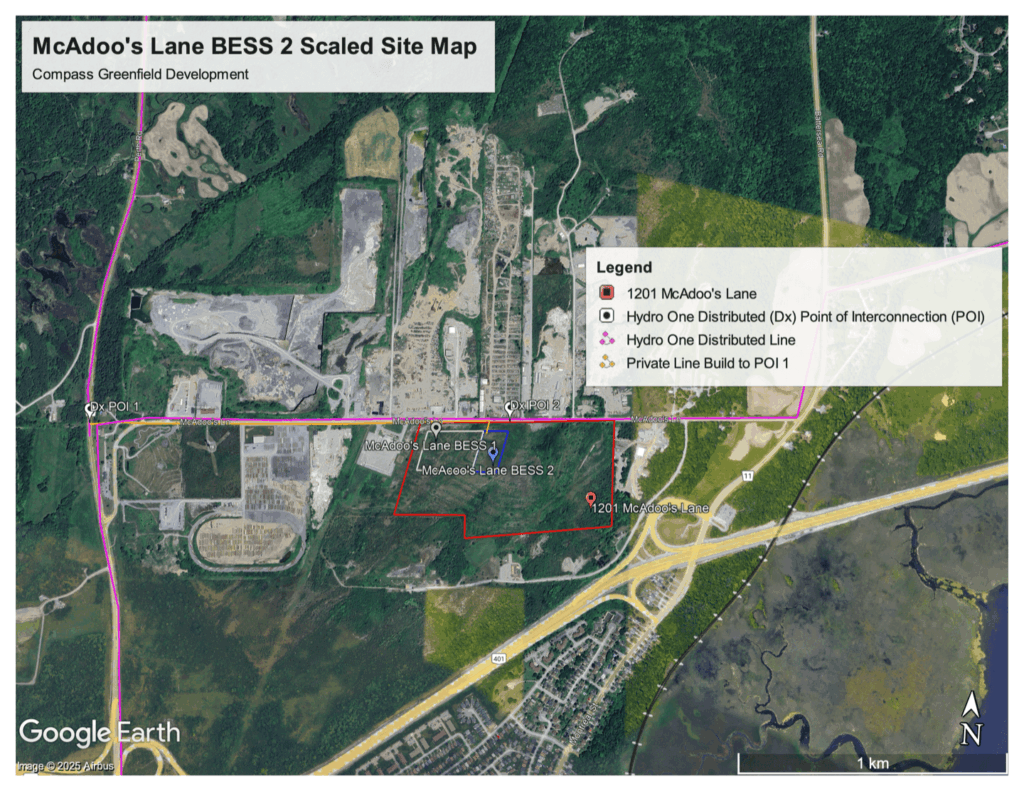
Both of these points have a priority rating from the IESO for new projects as shown on the “Revised Locational Preference Breakdown” document posted on the IESO website.
For a more detailed site plan, please see Figure 1: Walker BESS 4 Scaled Site Map
Figure 1: McAdoo's Lane BESS 2 Scaled Site Map
Benefits to the Community
There are various economic and non-economic Community Benefits associated with McAdoo’s Lane BESS 2, a proposed key energy infrastructure project located in the City of Kingston. The McAdoo’s Lane BESS 2 Project will provide power to meet growing provincial demand, lease revenues for local landowners, additional property taxes for the City of Kingston and economic activity within the City of Kingston.
Further to this the Project will have the following benefits:
- Job Creation, Local Economic Stimulus: Construction will lead to a creation of jobs. We are actively engaging with local contractors to perform site construction. On-site activity will boost the revenues of local business during construction.
- Community Benefit Agreement (CBA): CGD will commit to an annual payment of $1,000/MWac to the municipality.
- Decommissioning Securities: CGD is required to decommission the Project at the end of its useful life. To ensure there are funds available for decommissioning, we post financial security to ensure the work is completed.
- Diversified income stream for local landowners: keep landownership within your municipality.
- Increased tax base for the municipality.
Battery Energy Storage Systems support the integration of flexible generation resources and provide intelligent resilience to the regional electricity grid. The McAdoo’s Lane BESS 2 Project will further support the electrification of transport and the environmental sustainability goals laid out by the plans from the City of Kingston.
Anticipated Project Timelines
2025
Land Lease
- Review of Land Designation
- Interconnection assessment
2025
IESO Procurement
- Consultation with municipality and neighbors
- Indigenous Community Engagement
- Municipal Support Resolution
- Submission of Project to LT2-(c) Window 1 Procurement Prior to December 18th, 2025
2026 → 2027
Engineering, Design & Approvals
- IESO contract award
- Indigenous Community Engagement
- Provincial Permitting
- Municipal Permitting
- Electrical Permitting
- Design and construction is planned with the landowner’s land-use in mind
2028 → 2029
Commercial Operation
- Construction
- BESS Equipment is installed.
- Local electrical grid connection occurs
- Remote monitoring
- Annual maintenance
2051
Decomissioning
- Equipment is removed
- Land fully remediated
- Opportunity for
re-commissioning
Project Updates
June 2025 – Commercial Operation
We are proud to share that Walker BESS 4, Walker BESS 5, and Walker BESS 6 have all completed construction, commissioning and the interconnection process. All 3 projects have achieved Commercial Operation.
September 2024 – Construction Start
We are happy to share that we have broken ground on the construction of Walker BESS 4, Walker BESS 5, and Walker BESS 6.
July 2023 – Contract Award
We are happy to announce that Walker BESS 4, Walker BESS 5, and Walker BESS 6 (the “Walker Projects”), our lithium-ion battery energy storage projects located in Windsor, ON, have been successful in the IESO’s Expedited Long-Term 1 (E-LT1) procurement. We look forward to working with the City of Windsor and the local community throughout the development of the Walker Projects, and as such we are issuing our inaugural newsletter, which highlights the project development and construction roadmap ahead.
Project Updates
Watch this space for updates on the McAdoo’s Lane BESS 2 Project.
Notice Of Public Community Meeting
Meeting Date and Time
September 30th, 2025
6:30 PM – 8:30 PM
Meeting Location
Public Community Meeting Minutes
Community Meeting Presentation
Previous Community Meetings
Notice Of 1st Public Community Meeting
Virtual Public Community Meeting Date and Time
November 10, 2022
6:00 PM – 8:00 PM
Public Community Meeting Summary
Community Meeting Presentation
Notice Of 2nd Public Community Meeting
Virtual Public Community Meeting Date and Time
February 8, 2023
6:00 PM – 8:00 PM
Public Community Meeting Summary
Community Meeting Presentation
Notice Of 3rd Public Community Meeting
Public Community Meeting for Walker BESS 4, 5 & 6
Meeting Date:
September 4th, 2024
Meeting Time:
7:30 to 8:30 PM
Meeting Venue:
Forest Glade Community Centre – Wildwood Room
3215 Forest Glade Dr, Windsor, ON N8R 1W7
Community Meeting Posters
Community and Indigenous Engagement Plan
McAdoo’s Lane BESS 2 is developing a Community and Indigenous Engagement Plan that identifies a strategy for establishing and sustaining a transparent and productive engagement with Community stakeholders and Indigenous Communities. When posted, we would encourage interested stakeholders to review this document to understand the McAdoo’s Lane BESS 2 Project’s community engagement process.
Developer Background
Capstone is generating our low-carbon future, driving the energy transition forward through creative thinking, strong partnerships, and a commitment to quality and integrity in how we do business. A developer, owner, and operator of clean and renewable energy projects across North America, Capstone’s portfolio includes approximately 776 MW gross installed capacity across 30 facilities, including wind, solar, hydro, biomass, and natural gas cogeneration power plants. Please visit www.capstoneinfrastructure.com for more information.
Wahgoshig Solar FIT5 LP
Wahgoshig Solar FIT 5 LP (“Wahgoshig Solar”), is a partnership formed between Wahgoshig First Nation and Compass Renewable Energy Consulting Inc. Wahgoshig Solar developed, constructed, and operates four 500 kWac/600 kWdc (2.4 MWdc total) ground mount Feed-in Tariff (“FIT”) projects under the former FIT program in Ontario. Wahgoshig Solar engaged Compass to manage the development, permitting and construction of these facilities.

Compass Renewable Energy Consulting Inc. (“Compass”) has been consulting and developing renewable and clean energy projects in Ontario for over 10 years. We have experience across the development lifecycle from pre-screening, contracting, construction, commissioning and operations. We have developed over 100 renewable energy projects in Ontario representing over 100 megawatts (MW) in the last 6 years and supported the development of over 2,000 MWs for our clients.

Compass Greenfield Development (CGD) was born out of Compass Renewable Energy Consulting Inc., and our team members have been developing in Canada and the U.S. for over a decade, with experience across the development lifecycle from pre-screening, contracting, construction, commissioning and operations. Our team members have developed, permitted, financed and constructed hundreds of megawatts of renewable energy projects in Canada and abroad.
CGD leverages our consulting DNA, implementing a proven process, to identify and advance greenfield development opportunities for solar and battery energy storage. We have a long-term strategic perspective coupled with on the ground experience in doing the doing that results in projects getting to commercial operation. All of our stakeholder’s benefit including landowners, municipalities, Indigenous partners, investors and the public at large.
CGD was successful in securing Battery Energy Storage contracts in both the Expedited Long Term 1 and Long Term 1 procurements in 2023 and 2024 respectively.
CGD is the developer that brought the first battery energy storage system into commercial operation under the IESO’s Expedited Long Term procurement, The Walker 4, Walker 5 and Walker 6 facilities located in Windsor, ON.
You can read more about these projects here:
Frequently Asked Questions
Energy storage fundamentally improves the way we generate, deliver, and consume electricity. Energy storage helps during emergencies like power outages from storms, equipment failures and accidents. The major benefit of energy storage is its ability to balance power supply and demand instantaneously – within milliseconds – which makes power networks more resilient and efficient.
BESS systems occupy a considerably smaller footprint compared to other clean technologies such as solar or wind farms. On average, a 20MW 4-hr BESS system occupies approximately 1.75 acre of land.
BESS have to apply with municipal, provincial and national permitting and codes and standards.
The following is a non-exhaustive list of industry standards our Project will comply with:
- UL 9540 Standard for Energy Storage Systems and Equipment
- UL 9540A Test Method for Evaluating Thermal Runaway Fire Propagation in Battery Energy Storage Systems
- National & Provincial Building Code
- National Fire Code Canada
- Underwriters Laboratories of Canada
- NECB 2017 National Energy Code of Canada for Buildings
- ULC (Underwriters Laboratories of Canada)
- UL 1741 Standard for Inverters, Converters, Controllers, and Interconnections
- UL 1973 Standard for Batteries for Use in Stationary, Vehicle Auxiliary Power and Light Electric Rail (LER)
BESS are certified to UL9540 and UL9540A standards to prevent fire spread at the cell, module BESS system level. BESS enclosures have built-in early fire detection systems. These include temperature sensors, smoke detectors, gas detectors, whose main function is to detect abnormalities in the operation of the BESS and automatically stop operations. In the rare event of a fire, the BESS are designed and tested to prevent fire spread between cells, modules and containers.
These BESS projects do not use lead acid batteries and therefore do not leak.
Mechanical failures include physical damage that could create heat or a fire. Hazards associated with lithium-ion battery energy storage systems are centred on the flammable organic electrolyte and its highly reactive electrodes. However, if the batteries are punctured, there is a risk of electrolytes being exposed to air, which will result in a chemical reaction, leading to thermal runaway and combustion.
Other potential hazardous wastes could include fire residue, debris and fire extinguishing agents. The management of these wastes starts at the cell level, with the selection of battery chemistry, and compliance with local AHJs and global certifications. This is where UL9540A certification becomes critical to BESS projects. Any hazardous leaks will be contained in the enclosure.
In the event of a fire, our storm water management system and emergency response plan will ensure that we collect any fire water for removal so that it will not leach into the ground.
To allow for our connection to the Hydro One grid we are bound by the BESS Fire Protection Risk and Response Assessment Standard, which requires us to complete several assessments including:
- Hazard Mitigation Analysis
- Fire Risk Assessment
- Fire Protection Design Documentation
- Commissioning Plan
- Decommissioning Plan
- Emergency Response Plan
We are required to submit a self declaration as part of connection process with Hydro One and make these documents available upon request.
BESS facilities have an expected lifespan of 25 years, or more, with equipment replacement and repowering. At the time of decommissioning, the installed components will be removed and reused/recycled, where possible, and the site restored. All removal of equipment will be done per the applicable regulations and manufacturer recommendations. The below summarizes the decommissioning procedure that would be enacted at the end of project life for each component.
- BESS – Disconnect all above-ground wirings. Remove all BESS enclosures and support structures.
- Medium Voltage (MV) Stations, Substation – Disconnect and remove all electrical equipment. Remove the inverter and associated equipment. Remove high-voltage substation transformer. Remove concrete foundations for MV Stations and substation components.
- Access roads and other components – Consult with the property owner to determine if access roads should be left in place for their continued use. If roads are to be removed, the aggregate materials will be excavated by a backhoe/front-end loader, along with any underlying geotextile fabric. Compacted areas restored.
- Underground cables – Underground electrical lines running between the inverters and the substation will be removed. All foundation materials will be removed.
This scale of BESS projects generally take between 6 to 12 months from the start of construction till commissioning.
As part of the Environmental Activity and Sector Registry (EASR) permitting process, a Noise Impact Assessment is completed for the project and submitted to the Ministry of Environment Conservation and Parks. This includes an ambient noise survey to establish the existing ‘noise envelope’ at the site, taking into consideration zoning, nearby highways, and other relevant factors. The assessment determines if the BESS will operate within the sound level limits outlined in Chapter 3 of the EASR Publication at all nearby points of reception.
The safety of people, first responders and neighbours are our priority. We are taking a proactive approach to ensuring a safe and efficient operation. Safety is being addressed with a multi-layered approach:
- Battery Chemistry: Lithium Iron Phosphate (LFP) batteries have a lower energy density, and a more stable chemistry, making them safer and less likely to overheat.
- Equipment has been selected based on track record, planning and testing, monitoring, automation, isolation, and suppression.
- 24 hour monitoring of battery operations and cell temperatures, including gas detectors, smoke detectors and temperature detectors.
- If any abnormality in the operations are detected, the system shuts down and alerts the operator.
- The battery system is tested to UL9540A standards which require that fire will not propagate between battery units in the unlikely event of a critical failure.
The project owner will provide and pay for training for the local fire department on how to best manage different types of emergencies related to the battery system.
Electric fields are produced whenever a conductor such as a power line is connected to a source of electrical voltage. Magnetic fields are produced whenever an electrical current flows in a conductor. An example of this is the plugging of a lamp into a wall outlet in a home. When the lamp is plugged in, a voltage is induced in the cord to the lamp that causes an electric field to be created around the cord. In this example, if the lamp is turned on allowing electricity to flow to the lamp, a magnetic field is created around the lamp cord in addition to the electric field.
For the BESS system, the magnetic field will vary with the amount of power being charged or discharged, and the time of the day when the charging and discharging would occur. However, the strength of both electric and magnetic fields will decrease rapidly with distance from the source – for each doubling of the distance from the EMF source, the EMF will drop by a factor of eight. Electric fields will also diminish from absorption by any vegetation (including low-growing vegetation) located in its path because the plants effectively ground the electric fields.
There will be a short distance from the BESS to the connection point where the EMF would be created. More importantly, there are few to no buildings in the vicinity of the connection point.
If deemed necessary by authorities having jurisdiction, measurements of magnetic fields could be made before construction of the Project and after the Project begins operating to assess whether EMF from the Project’s electrical infrastructure would extend into the neighbouring area.
Construction of the Project would happen in phases and be carried out by small teams of 5-10 attending to site work in an ordered manner to avoid any traffic management issues at the site. The phases would generally focus on the civil works, mechanical installation, electrical connection, and landscaping. It was highlighted that after construction and commissioning of the project, there would be minimal employee traffic to the site as the BESS will be remotely monitored and scheduled site visits would happen quarterly to ensure stable operations and effective preventive maintenance.
The number of containers depends on the density of the battery technology which continues to advance. The project will use approximately 35 containers within about 1.75 acres of land depending on the supplier use, and will have the capacity to add additional containers in the future.
Compass Greenfield Development will be responsible for maintaining the project. Regular maintenance of the electrical and battery equipment includes ongoing 24-hour monitoring, as well as regular scheduled maintenance, like other electrical equipment. These include changing filters on HVAC equipment and visually inspecting connections in the equipment.
The project owner is required to maintain the BESS project. The project will be remote monitored 24/7, 365 days per year by I) the project owner, ii) a dedicated third-party vendor and iii) the battery manufacturer. This monitoring is focused on voltage, temperature and gas detection, any of which will alert the operators. Further, any critical abnormalities would automatically isolate to make the system safe. It will have regular scheduled maintenance and unscheduled maintenance as required.
The project will be fully insured for the duration of construction and life of the project. Insurance will cover environmental cleanup caused by the battery system and costs to the municipality for deploying fire fighters to address a fire or emergency on site.
Environmental Site Assessment (ESA) Phase 1: Identifies any potential environmental concerns in relation to the Site. A Phase II ESA will be carried out if deemed necessary.
Environmental Activity Sector Registry (EASR): Identifies if the combined sound level resulting from operating the facility at each affected point of reception is less than or equal to the applicable sound level limit set out in Chapter 3 of the EASR Publication (determined using an acoustic assessment).
Emission Summary and Dispersion modelling report: Will determine if the facility will have significant sources of air emissions.
Species At Risk (SAR) Screening: Will confirm that no SAR specimens or critical habitats are evident in the agriculture field. Due to long-term use of the Site for agriculture and local factors, the potential habitat available for fish, wildlife, and plants is likely to be very limited.
The BESS projects procured by the Independent Electricity System Operator (IESO) help ensure grid reliability by storing electricity when supply is high and delivering it during peak demand. The electricity stored will be dispatched by the IESO and conveyed through the nearby Transformer station to the broader grid—ultimately used by homes, businesses, and industries across Ontario.
The major equipment on site that has anything that can spill are the primary oil filled transformers (three in total). As part of our Environmental Compliance Approval, we will maintain an oil containment system to capture any oil that spills or leaks from the transformers. In addition, we will be remotely monitoring oil temperature and levels to allow us to detect any issues and dispatch a response team.
In the event of a large leak in oil into the containment system, the project owner has retained environmental response experts to provide 3rd party remediation services in the event of a spill or release impacting the environment. These contractors perform and not limited to the following services:
- Emergency spill response services (Containment equipment, Bulk waste removal equipment & Chemical response technicians)
- Dewatering and Containment (Including Large containment tanks, Transfer pumps and Vacuum trucks)
- Industrial firefighting (Firefighting assets and personnel to assist the municipal fire services if required)
- Environmental engineering and Consulting (Soil & water testing, On-site & community air monitoring, Environmental reporting)
- Environmental remediation services (Heavy civil equipment, Ground water treatment)
- Licenced waste receiving facilities (Soil & liquid)
In the unlikely event of a release to the environment, the project owner will immediately dispatch emergency crews sourced locally and provincially to attend the site with response and remediation assets. Upon approval from the local authorities and working in conjunction with the fire department, these assets will mobilize on site.
The project owner is responsible for complying with the Ontario Environmental Protection Act, R.S.O. 1990, c. E.19 and all spills and releases impacting the natural environment will be reported immediately.
Contact Us
It is important to us that McAdoo’s Lane BESS 2 be successfully integrated into the City of Kingston and we are seeking to incorporate feedback through Public Community Meetings and this Project Website into the development of this Project.
To submit feedback or send us any questions about the project, please contact us:
Email:
info@mcadooslaneenergystorage2.ca
By mail:
192 Spadina Ave, Suite 510
Toronto, ON M5T 2C2